
Stay informed and inspired in the world of AI with us.

In agriculture, missing data is part of the job. Farm data comes from different sources, under changing field conditions, and at different points in the growing cycle, so a complete and perfectly synchronized dataset is rare. AgTech models still have to work with whatever information is available. Some gaps barely affect the result, while others remove an important part of the signal. Knowing the difference is what makes the model useful outside a clean development dataset. Agricultural data is
Published: September 24, 2026
When an Air Canada customer asked the airline’s website chatbot about bereavement fares, it told him he could book first and claim the discount within 90 days. The same answer linked to a policy page saying retroactive requests weren’t allowed. The passenger followed the chatbot’s instructions and later had his refund request rejected. The civil tribunal found the airline liable for negligent misrepresentation after concluding that he’d reasonably relied on the inaccurate guidance. The correct i
Published: September 18, 2026
Microsoft spent $37.5 billion on infrastructure in the quarter ending December 2025, with roughly two-thirds going mainly to GPUs and CPUs. At this scale, even modest waste is expensive. NVIDIA found that idle workloads consumed about 5.5% of GPU capacity across its research clusters. By combining GPU telemetry with job data and automatically clearing stalled or abandoned workloads, it reduced that waste to about 1%, potentially saving millions. Scale down the arithmetic and the pattern holds: a
Published: September 11, 2026
Forward deployed engineer was once a niche title used mainly by companies such as Palantir. It now appears across OpenAI, Anthropic, Google Cloud, Scale AI, and other enterprise AI providers. FDE brings software engineering, technical consulting, and project delivery into one role. Its growth also shows what enterprise AI companies now need from engineers: an understanding of customer workflows, the ability to make sound technical decisions, and responsibility for moving a system into production
Published: September 4, 2026
California's ALERTCalifornia network shows where production computer vision becomes an operational system. In 2025, it helped Cal Fire respond to roughly 3,600 wildfire incidents, with cameras detecting smoke before the first 911 call in more than half of them. The cameras accelerate detection; Cal Fire retains control over the response that follows. Galicia runs a similar model. Its system, Xeocode, scans camera and satellite feeds with convolutional neural networks trained to catch a rising sm
Published: August 28, 2026
In 2025, Waymo's driverless vehicles crossed a threshold: independent, peer-reviewed data, not company demos, backed up the safety claims. A peer-reviewed analysis of 56.7 million rider-only miles found a 92% drop in pedestrian injury crashes compared to human-driver benchmarks, plus a 96% reduction in intersection crashes and an 82% reduction in cyclist and motorcyclist injury crashes. Waymo's own dashboard has since tracked the pedestrian figure at 220.6 million miles — more than triple the st
Published: August 18, 2026
A health database rarely captures the exact clinical state a researcher wants to study. It contains traces of that state: diagnoses, medication orders, laboratory results, procedures, changes in the level of care, and clinical notes. These records support care, communication, billing, and hospital operations. They were not created for future research questions. Computable phenotyping turns these traces into an algorithm for identifying patients, clinical events, or periods of interest. The proce
Published: August 14, 2026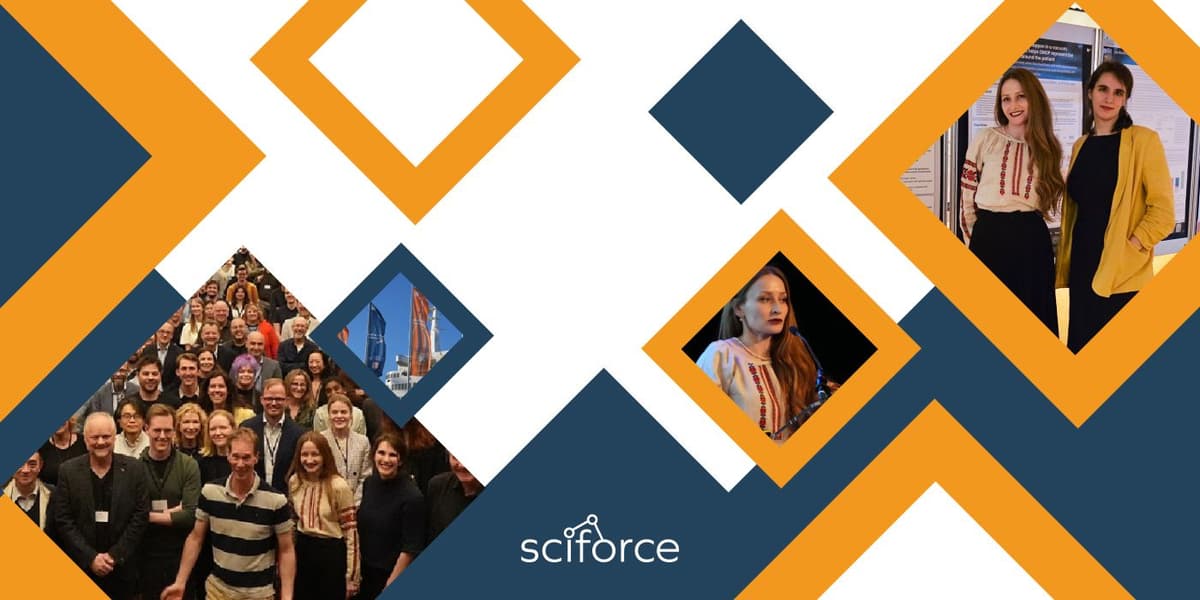
This April, Polina Talapova and Mariia Pahur represented SciForce at the 7th European OHDSI Symposium in Rotterdam – three vivid days of workshops, poster sessions, MindMeetsMachines mapping competition and an oral presentation aboard the SS Rotterdam, a retired ocean liner moored on the Maas river. The symposium's theme was Continuous Collaboration for Living Evidence Generation. The word "living" matters here. Traditional evidence-generation projects are often designed as discrete studies. A
Published: July 21, 2026
Building a telehealth platform at clinical scale means solving for hospital network restrictions, HIPAA compliance and auditability, and the data load of continuous remote monitoring – and the architecture decisions that determine whether it holds up are mostly made in the first few sprints. The engineering debt from early decisions starts showing up at scale: video sessions dropping when hospital firewalls, restrictive egress policies, or network address translation prevent a direct media path;
Published: July 7, 2026
A radiologist on a standard hospital shift may read dozens to well over a hundred imaging studies, depending on subspecialty, setting, shift structure, and case complexity. Each one is a search for something that might be subtle, easy to miss, or buried in noise. At that volume, non-trivial discrepancy or error rate is a known risk in radiology practice, especially under high workload and time pressure. Radiologists are working through growing imaging volumes with a workforce that has never full
Published: June 30, 2026