At the beginning of April 2021, Neuralink’s new video featuring a monkey playing Pong with his mind hit the headlines. The company’s as-always-bold statements promise to give back the freedom of movement to people with disabilities. We decided to look beyond the hype and define what these brain-computer systems are capable of in reality. Let’s dive right into it.
Brain-computer interfaces (BCIs) or Brain-machine interfaces (BMIs) capture a user’s brain activity and translate it into commands for an external application. Though both terms are synonymous, BCI uses externally recorded signals (e.g., electroencephalography) while BMI gathers the signals of implanted sources. We are using the BCI term further as an inclusive one, implying that both brain and system are on par in interactive, adaptive control crucial for successful BCI.
What are the BCI applications? Initially, the development of BCIs was aimed to help the paralyzed patients to control assistive devices with their thoughts. It is also crucial for stroke patients’ rehabilitation devices.
BCI has proved to be efficient with various mental activities like higher-order cognitive tasks (e.g., calculation), language, imagery, and selective attention tasks (auditory, tactile attention, and visual attention).
In practice, the BCIs can help people who have lost the freedom of movement to restore their independence in daily life. In March 2021, the BrainGate research consortium presented the wireless brain-computer interface replacing the “gold standard” wired system. Though the wireless BCI system is the very first step to the primary goal, it can provide the ability to move for the patients without the caregiver’s interaction. Moreover, BCIs enter the mass market with new use cases, and we are going to dwell on it further.
What are the types of BCIs? Brain-computer interfaces can be divided into three major groups, depending on the technique that is measuring the brain’s signal:
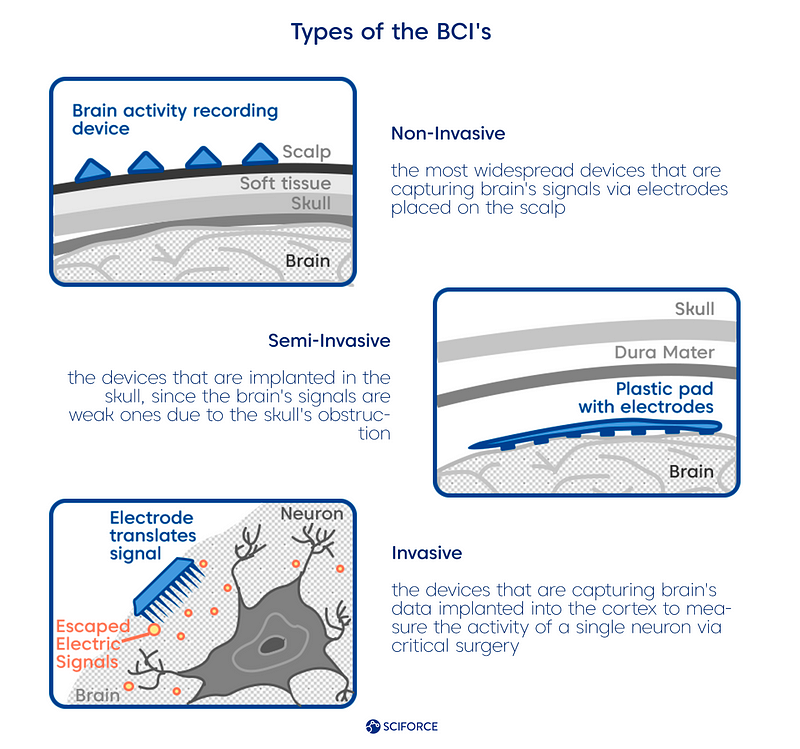
What types of brain’s signal BCI is acquiring? The system can use any brain’s electrical signals measured by applications on the scalp, on the cortical surface, or in the cortex to control external application. Speaking formally, the most researched signals are:
In general, the BCI system is a communication and control system bridging the brain’s activity and an output device (e.g., robotic arm or cursor).
Per Jerry J. Shih et al., BCI components include signal acquisition, feature extraction, feature translation, and device output.
Also, there is a pre-stage of signal production — stimulating the signal by presenting the stimuli to the subject or recording the already generated brain waves.
The signal acquisition means measuring the brain’s signals using EEG techniques for the brain’s electric signals or fMRI for the brain’s blood flow to define the user’s intentions. The principal is relevant to other approaches.
Feature extraction means analyzing the digital signals to define the user’s intent, filtering out irrelevant signals, and “compressing” them into a suitable form for feature translation.
Feature Translation is when the signals are converted into the commands for the output’s device reflecting the user’s intent.
Device Output supports the functions like letter selection, robotic arm operation, cursor control, etc. This function provides feedback for the user, closing the control loop.

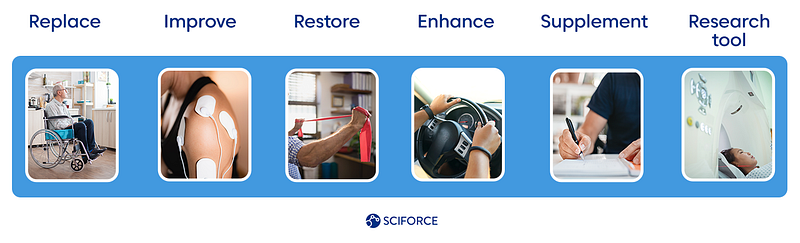
Per the European Commission initiative for BCI research, Brain/Neural Computer Interaction Horizon 2020, the actual applications include:
In the course of the last two years, BCI researchers are concentrating on the applying of new techniques. Recent developments in the field imply using deep learning, computer vision, unsupervised learning, and telemedical practices.
Machine learning techniques. Since online usage of BCIs generates unlabeled data, the authors of the recent research (David Hübner et al.) opted for unsupervised learning to design a novel classification approach.
K. Palani Thanaraj et al. demonstrated the effectiveness of using deep learning networks for epilepsy detection. This implies the broader usage for further development with these techniques in the field of BCI.
TeleBCI. Simultaneously, a spike in telehealth impacts the BCI too. By telehealth, we mean delivering healthcare services remotely via modern electrical devices. Check our post “Top 5 Medical Specialties Most Interested in Telehealth” for details.
As one research shows, teleBCI (telemedical BCI) could provide an alternative way of communication like a virtual keyboard for paralyzed patients (Andrew Geronimo & Zachary Simmons).
As BrainGate use case of wireless BCI shows, assisting the patients who are using remote BCI systems is particularly helpful under the pandemic.
Computer vision. The combination of neuroscience and computer vision is an emerging trend. Researches show the efficiency of using machine learning techniques to understand the brain’s activity patterns in the “EEG-as-image” approach (Jacob Jiexun Liao et al.).
Communication and motor functions’ restoring. Improvements in restoring motor and communication functions include using noninvasive EEG-based BCIs (Aziz Koçanoğulları et al.).
Alborz Rezazadeh Sereshkeh et al. showed how the measurements of EEG and fNIRS could enhance the classification accuracy of BCIs for imagined speech recognition.
It is already happening. The Canadian startup Muse developed an EEG-based application to measure sleep and focus quality and assist in meditation. Dream is another consumer-targeted BCI headband for sleep improvement.
Moreover, market segments like virtual gaming, military communication, and home control systems are the primary drivers in the industry. For example, NeuroSky, a US company is developing EEG-based headbands for gaming and development since 2009. Other companies like Neurosity and NextMind are developing devices for visual attention decoding and productivity enhancement.
What are the BCI’s actual market size and forecasts? The forecasts for the BCI field are promising.
The expected revenue in 2027 is USD 3,7 billion, growing from the 2020 USD 1390,49 million with CAGR (Growth Annual Compound Rate) of 15%.
Trends in BCI promise that more user-friendly and portable devices will be spreading to narrow clinical niches and the mass market. Moreover, hi-fidelity signal acquisition, processing, and application of machine learning techniques contribute to the industry’s developments.
Additionally, as researchers state that the future of BCI relies intensely on the following factors:
All in all, we are witnessing significant life quality enhancement with the BCI in the next few years. Got inspired? Do not forget to clap for this blog post and give some inspiration back to us.