• Services
    LLM
    AI & ML
    Digital Healthcare
    Data Science
    DevOps
  • Products
    Jackalope
    EyeAI
  • Industries
    Healthcare
    Agriculture
    EdTech / LMS
    Retail / E-commerce
    Manufacturing
  • Resources
    Blog
    Case Studies
    Expert Guides
  • Company
    About us
    Careers
  • Contact us
logo
Services
LLMAI & MLDigital HealthcareData ScienceDevOps
Industries
HealthcareAgricultureEdTech / LMSRetail / E-commerceManufacturing
Case StudiesAbout UsBlogCareers
Our contacts
+380(66)54-32-579
sales@sciforce.tech

Get monthly digest of innovations

This site is protected by reCAPTCHA and the Google Privacy Policy and Terms of Service apply.
Social Media:
Privacy Policy © 2026 Sciforce
5.0
OHDSI Global Symposium

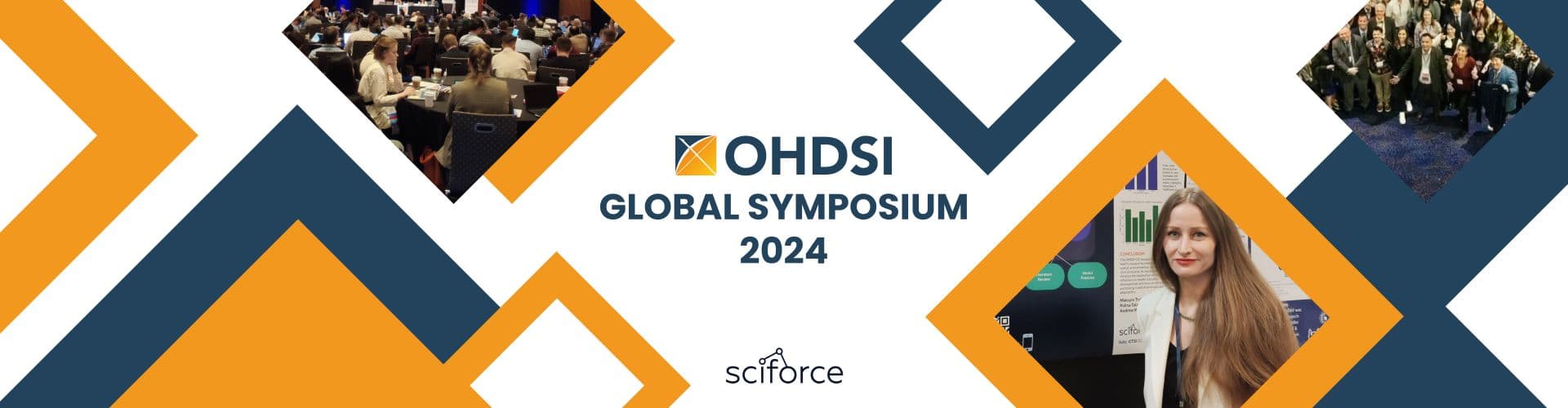
Bridging Innovation and Collaboration in Healthcare: SciForce at OHDSI Symposium 2024

Published: November 8, 2024
# Healthcare
# Big Data
# Data Science

AI Data Readiness Checklist: 10 Questions to Ask Firs

Find out more with SciForce free mini guide

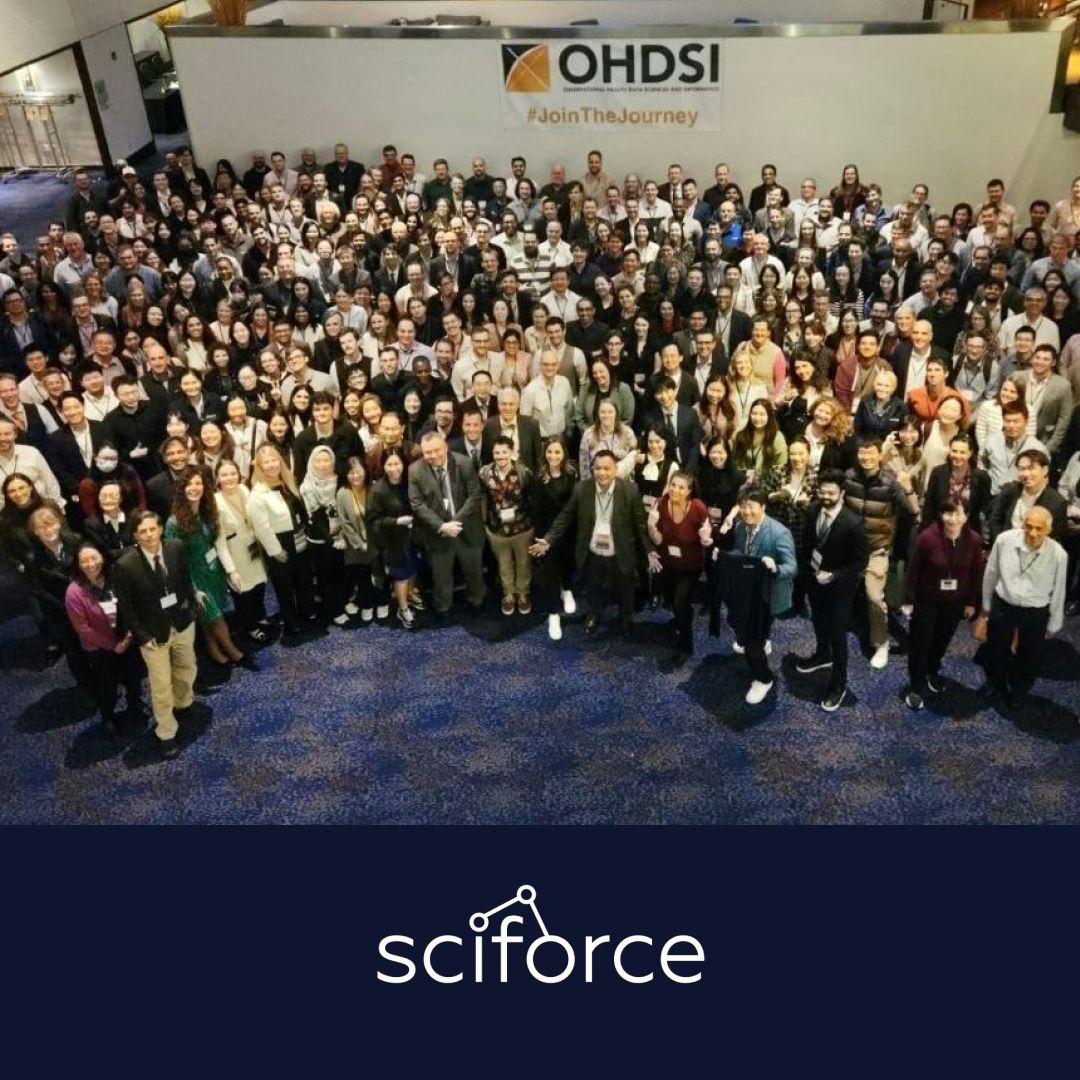
After an exciting time at the 10th Annual OHDSI Global Symposium at the Hyatt Regency in New Brunswick, NJ, SciForce is coming back with new energy! With over 470 experts gathered from around the world, our team, led by Polina Talapova, explored the latest tools and methods in OHDSI and OMOP. We tackled topics like data conversion, geospatial vocabularies, and Jackalope benchmarking, gaining valuable insights and sharing strategies to help move healthcare research forward. Educational Tutorial (October 22nd).
OHDSI_24_03.jpg

On October 22nd, we kicked off the event by leading an Educational Tutorial on how to use OHDSI Standardized Vocabularies in research. Polina Talapova, along with experts Anna Ostropolets, Azza Shoaibi, Vlad Korsik, and Oleg Zhuk, guided participants through essential steps like mapping clinical terms, building accurate conceptsets, and understanding vocabulary hierarchies. Sharing these practical skills helped participants apply vocabularies to their own research, making it a valuable session for everyone involved.

Conference Insights (October 23rd)

October 23rd was full of insights as we explored the latest in the OHDSI community. The main conference day offered a deep look into OHDSI’s current projects and future goals, emphasizing innovation, reproducibility, and openness. We reviewed a major study, LEGEND-T2DM, focused on diabetes treatments, and listened to talks that described new research, challenges, and practical uses for healthcare data.
OHDSI_24_06.jpg

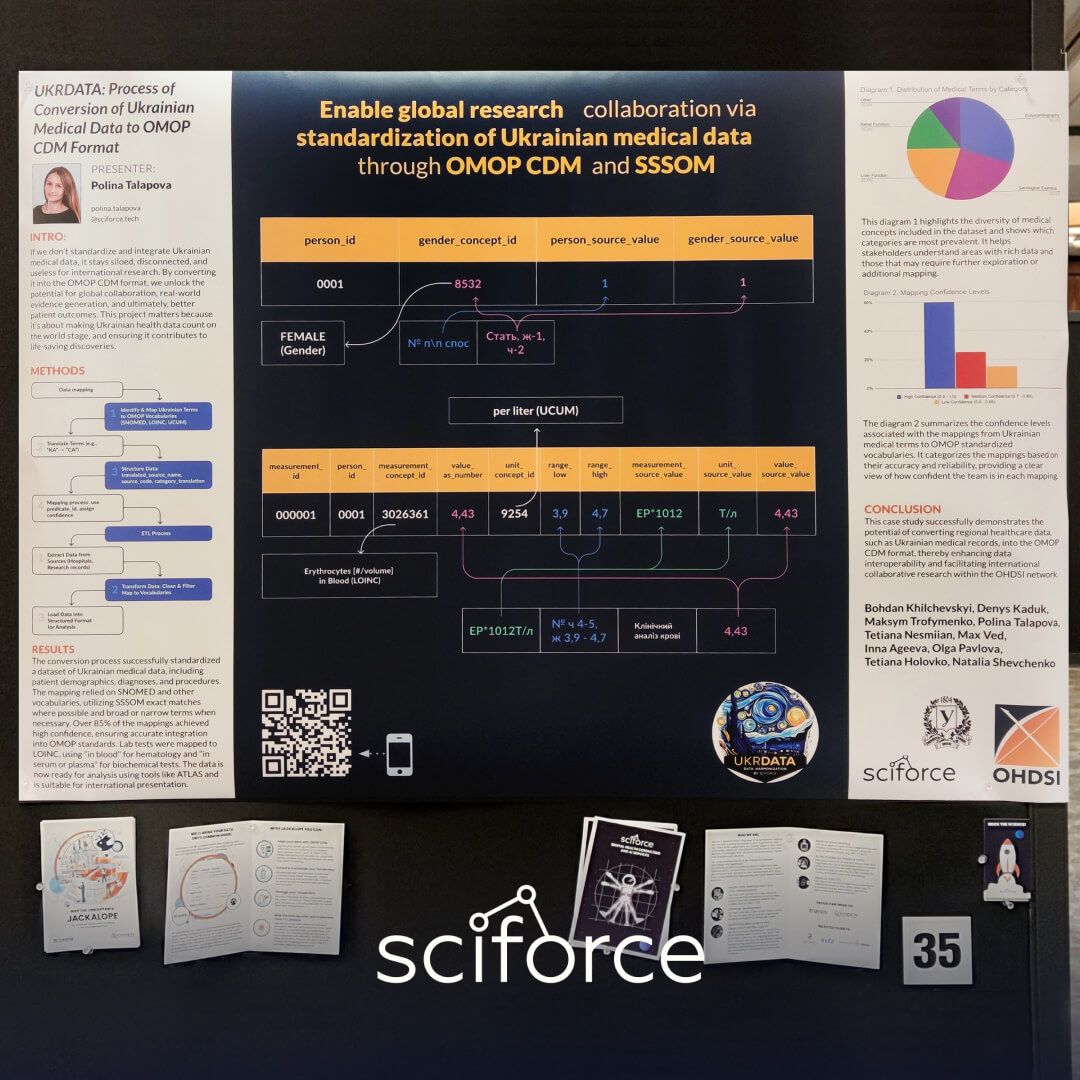
One of the event's highlights was the Collaborator Showcase: Posters and Software Demo, in which we displayed three of our posters:

  • "Process of Conversion of Ukrainian Medical Data to OMOP CDM Format" – part of our broader work on end-to-end clinical data standardization pipelines.
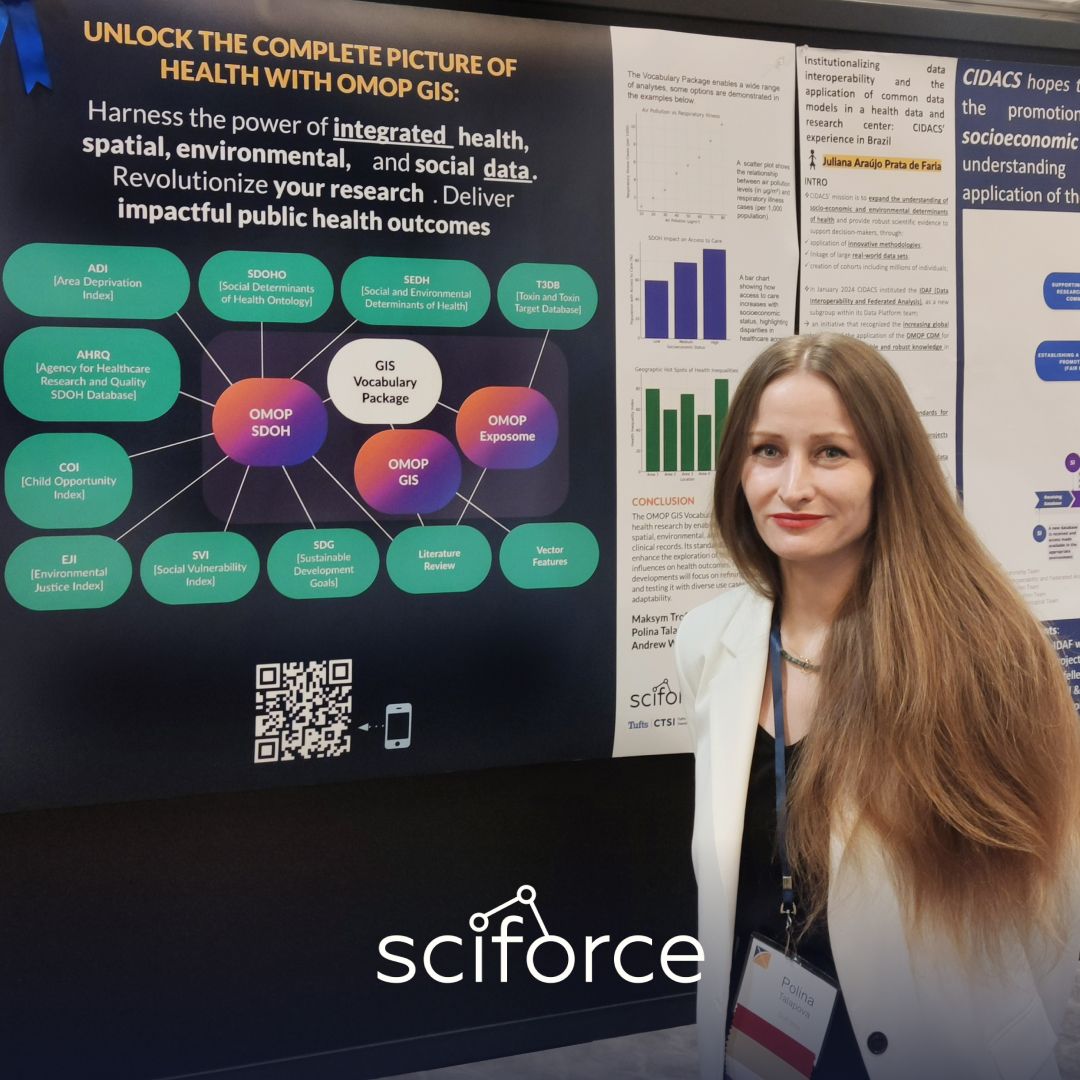
  • "OMOP GIS Vocabulary Package for Observational Studies in Health Care and Public Health" (thrilled to be the best contribution nominee!)
  • "Jackalope Plus Performance: Benchmarking and Competitors"

Sharing our work and seeing the community’s enthusiasm was beyond rewarding.

Workgroup Sessions (October 24th)

Geographic Information System (GIS) Workgroup Led by Andrew Williams, Kyle Zollo-Venecek, and Robert Miller, this session included a presentation from Polina Talapova and Jared Houghtaling on “Vocabularies Used for Representing Geospatial Data: GIS Vocabulary Package.” They shared insights into how combining geospatial and social data can enhance observational studies in healthcare and public health.

Vocabulary Work Group

In this session, led by Anna Ostropolets, we presented “EHR Flowsheet Data Harmonization.” We discussed our approach to harmonizing EHR data, addressed unmet vocabulary needs, and outlined plans for 2025. The session was highly collaborative, with innovative ideas shared to expand the scope of observational research.
Thank You to Our Supporters

OHDSI_24_01.jpg

We’re incredibly grateful to the amazing people who made this journey possible: George Hripcsak, Patrick Ryan, Craig Sachson, Elisse Katzman, Andrew Williams, Marty Alvarez, and the incomparable Anna Ostropolets. Your guidance and support drive our passion to keep contributing to this incredible community! As we leave the symposium, we’re not just bringing back badges, gifts, and notes – we’re bringing home fresh ideas, valuable connections, and a stronger drive to use data to improve health outcomes worldwide. Here are some of our key takeaways:

- Better strategies for integrating standardized vocabularies into research workflows, helping make data more consistent and easier to understand.

- Insights on using geospatial and social data to add depth to observational studies, making findings more useful for public health.

- New methods for harmonizing EHR flowsheet data, addressing gaps in current vocabularies, and planning for smoother data integration by 2025.

- Lessons LEGEND-T2DM on using observational data to assess treatment outcomes, creating more evidence-based paths in healthcare.

With these insights and the connections we’ve made, we’re ready to drive change, break new ground, and shape the future of healthcare together!

RELATED BLOG ARTICLES

View all Articles
How to Build Reliable AgTech AI When Farm Data Is IncompleteHow to Build Reliable AgTech AI When Farm Data Is Incomplete

In agriculture, missing data is part of the job. Farm data comes from different sources, under changing field conditions, and at different points in the growing cycle, so a complete and perfectly synchronized dataset is rare. AgTech models still have to work with whatever information is available. Some gaps barely affect the result, while others remove an important part of the signal. Knowing the difference is what makes the model useful outside a clean development dataset. Agricultural data is

# Agriculture
# AI / ML
# Data Science
Building Domain-Specific LLM SystemsBuilding Domain-Specific LLM Systems: When to Use RAG, Fine-Tuning, or Neither

When an Air Canada customer asked the airline’s website chatbot about bereavement fares, it told him he could book first and claim the discount within 90 days. The same answer linked to a policy page saying retroactive requests weren’t allowed. The passenger followed the chatbot’s instructions and later had his refund request rejected. The civil tribunal found the airline liable for negligent misrepresentation after concluding that he’d reasonably relied on the inaccurate guidance. The correct i

# AI / ML
# Data Science
# LLM
Computer Vision in 2026Computer Vision in 2026: Real-Time AI Systems Beyond Image Recognition

California's ALERTCalifornia network shows where production computer vision becomes an operational system. In 2025, it helped Cal Fire respond to roughly 3,600 wildfire incidents, with cameras detecting smoke before the first 911 call in more than half of them. The cameras accelerate detection; Cal Fire retains control over the response that follows. Galicia runs a similar model. Its system, Xeocode, scans camera and satellite feeds with convolutional neural networks trained to catch a rising sm

# Healthcare
# Retail / E-commerce
# Manufacturing
# Computer Vision
Computable Phenotyping in OMOPComputable Phenotyping in OMOP: Where Large Language Models Help – and Where They Do Not

A health database rarely captures the exact clinical state a researcher wants to study. It contains traces of that state: diagnoses, medication orders, laboratory results, procedures, changes in the level of care, and clinical notes. These records support care, communication, billing, and hospital operations. They were not created for future research questions. Computable phenotyping turns these traces into an algorithm for identifying patients, clinical events, or periods of interest. The proce

# Healthcare
# Data Science
# LLM