“The world is changed,” said Galadriel in the Lord of the Rings. What the elf queen could not foresee is the way the world would change. In her times magic was the only means to communicate and get information across the distance, now almost everyone has a smartphone equipped with sound wave recorders, cameras, acceleration gauges, gyroscopes, magnetometers, Wi-Fi internet and whatever manufacturers find attractive enough. We think that these technologies make our lives more comfortable and effective, and in this belief a new — Internet of Things — paradigm is born.
What is the IoT paradigm? In IoT, the whole world is turned into a global computer, which gets data from everywhere. The processor works on big data in some form, while the output is considered to be crucial for the mankind to survive: to use energy more efficiently, to evolve as a civilization, to protect health, welfare, and offsprings.
Such shift in understanding the IoT not as a technology but as a philosophical category explains why it has penetrated all spheres so quickly: from households and corporations to schools and hospitals.
In this blog post we’ll discuss the benefits of the IoT for education — the sphere that still remains farther to the background in terms of the IoT application, but can benefit from it at all stages. Besides, schools are meant to prepare students for entry into the adult world. As the IoT changes the landscape of their futures, it is crucial to change the space where students spend their formative years.
Most probably, when it comes to IoT-driven education, we imagine a certain technically advanced classroom equipped with smart whiteboard. It is valid, of course, but the IoT for schools begins far before stepping into classroom:
Internet of Things (IoT) application begins in connected schools buses that can tell parents when they would drop off children and provide the latter with internet access to revisit their homework. IoT automatically adjusts lighting and audio visual settings to a teacher’s specifications and monitors hallways and building perimeters to keep students safe.
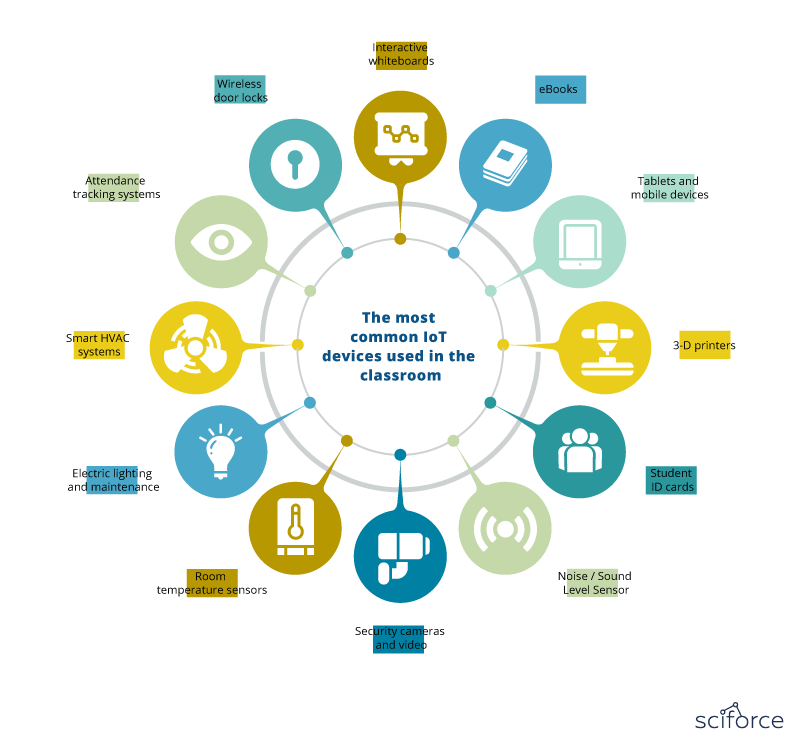
Within school buildings and in classrooms smart HVAC systems may help save money and energy by functioning only when needed. More Internet-connected devices, such as tablets, paired with analytic technology, can help educators monitor student attendance and activity during testing and classwork, and ultimately provide more agile, personalized instruction.
IoT enables this innovation through a growing collection of internet-connected technologies and devices — such as connected school buses, smart lighting and security cameras — all providing real-time data and valuable insights to students, parents, faculty and administration.
The most common IoT devices used in the classroom
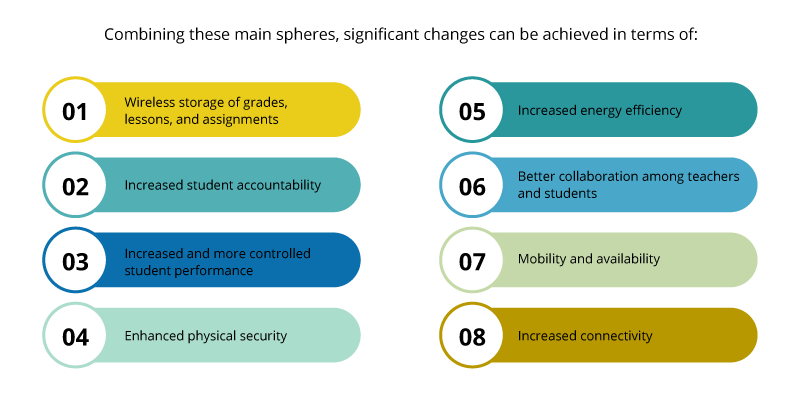
But returning to education process, how can smarter devices help educate smarter and tech savvy students? Here are some instrumental changes that those involved in education will soon begin to see:
Real-time insight and correction
Insight into a student’s progress, including test results, end-of-term reports, and possible peer reviews is a cornerstone of education. In future, students’ cognitive brain activity could be measured by neurosensors, and haptic vibrations could be sent to a student’s wearable or tablet to discreetly guide them back on task in case of them being distracted. Even now, smart devices make the process of knowledge monitoring more consistent and continuous: when IoT-enabled tablets replace traditional pens, teachers will be able to monitor the students’ notes that students in real time and to track their understanding. If they see that a student absorbs the information slowly, they can immediately take action by sending extra notes or exercises to bring the class up to the same level.
Better visualization
The IoT paradigm means interactive content will soon become the norm, and everything from distributing exercises to marking papers will become automated and streamlined. Smart whiteboards (here they are at last!) and screen can provide for optimized learning and at the same time engage more students into the education process. Visualization of difficult abstract concepts and immediate access to new information on the click can ensure better and more eager learning.
Safer environment
Smart tech is capable of making schools safer places. Such devices as, for example, IoT-enabled wristbands can register students’ entering and exiting the school premises — so no more sneaking out at lunchtime or between lessons. This measure also helps to prevent intruders and other unauthorized persons entering school premises.
It looks extremely promising, but some establishments and instructionists remain concerned about implementation of IoT in the real schooling environment. First of all, to integrate the devices in the classroom, the school will need to have capabilities such as reliable Wi-Fi, robust network bandwidth, a certain amount of devices for students, network analytics as well as teacher training. In other words, both the IT equipment and teaching strategies should support and have capabilities to use IoT in the classroom. Besides, some devices and applications may not be compatible and therefore would impede the organization’s ability to create an adequate IT environment.
At the same time, when devices begin measuring and collecting data from students, they are automatically putting the security and privacy of students at risk by storing sensitive data in an Internet-based network of connected devices prone to cyber-attacks. If connected devices penetrate all spheres this can compromise a student ID linked to an individual’s health record and even to the family’s financial information.
To sum it up, two main concerns about IoT in education are expensiveness and security.
However, students already live in a connected reality: in the smart cities, in buses and cars linked to the internet, with smartphones, smartwatches, tablets and laptops. Can they learn in a classroom with pen and paper note-taking from word of mouth presentations? To educate new humans schools have to adopt new technologies — and they will become smarter as they have no choice.